What is an immigration psychological evaluation?
It is a clinical assessment of your client’s mental health history and current functioning, documented in a written report your firm can file as evidence. A licensed clinician interviews the client and uses validated clinical instruments.
It is not therapy, and it is not legal advice. The report records clinical findings; your legal theory and the decision on how to use the report stay with you.
No evaluation guarantees an outcome. Its value is a clear, credible clinical record that sits alongside the rest of your evidence.
Which immigration cases use a psychological evaluation?
We evaluate for the most common forms of humanitarian and discretionary relief. Your referral tells us the relief type, so the clinician knows which clinical questions the report must address.
| Relief type | Form | What the clinician typically documents |
|---|---|---|
| Extreme hardship waiver («Perdón») | I-601 / I-601A | Clinical history and current functioning of the relative your theory centers on |
| Cancellation of removal | EOIR-42B | Clinical findings for the family members your case relies on |
| VAWA self-petition | I-360 | Psychological history and current symptoms the client reports |
| U status | I-918 | Psychological history and current symptoms the client reports |
| T status | I-914 | Trauma history and current symptoms |
| Asylum | I-589 | Trauma history, current symptoms and, where supported, PTSD |
| Medical disability exception | N-648 | Clinical findings related to the exception [confirmar: alcance de la evaluación N-648] |
| Mental competency | — | Clinical findings on the questions you raise [confirmar: alcance de competencia mental] |
Other humanitarian cases can also be evaluated; call us to confirm fit before you schedule. For client-facing explanations in Spanish, see our guides to the Perdón (extreme hardship) evaluation, the VAWA evaluation and the asylum evaluation and trauma report.
What does the written report include?
Our reports follow a consistent structure, so you know what you are filing before it arrives. Each report covers:
- Clinical history and background, gathered directly from the client.
- Instruments used, with scores and their interpretation.
- Mental status exam at the time of the interview.
- Diagnostic impressions, included only where the clinical data supports them.
- Findings tied to the legal standard for the relief you identified.
- Clinician licensure, credentials and CV.
Diagnoses are never added to strengthen a case. If the data does not support a diagnosis, the report says what it does show. For background on how trauma presents clinically, see our article on understanding PTSD beyond the stereotypes(Spanish).
How do I refer a client for an immigration evaluation?
Referral takes one call. Your firm gives us three things; case facts come from the client directly during the interview.
- Contact us. Call (972) 695-3421 (Mon–Fri 9 a.m.–7 p.m., Sat 9 a.m.–2 p.m. CT) or send the short form on our attorney referral page. Attorney calls are answered the same day; forms within one business day.
- Share the basics. Relief type, target filing date, and how to reach your client. The web form is not encrypted, so do not include client names or case details there.
- We schedule the client. We contact your client the same day and aim to hold the interview that same week, including weekends.
- The interview. Conducted in English or Spanish, in person at one of our four offices or by video.
- The report. Released to your client, and to you with their written authorization, on the delivery date chosen at booking.
How long does the report take, and what does it cost?
The fee is the same for every relief type. Only the delivery speed changes; the evaluation and report are identical.
| Option | Fee | Report delivered |
|---|---|---|
| Standard | $775 | 7–10 days after the evaluation [confirmar: días naturales o hábiles] |
| Express | $875 | Up to 5 days after the evaluation |
| Next day | $975 | 24 hours after the evaluation |
Express and next-day delivery depend on clinician availability, which we confirm when booking. The clock starts once the evaluation is complete.
Evaluations are private pay; health insurance does not cover them. Corrections or added information that need no new interview are free. A re-evaluation costs $380, with limits if much time has passed.
Plan backward from your filing date. If the deadline is tight, tell us on the first call so we can confirm an express or next-day slot. Spanish-speaking clients can read our guide to what an immigration evaluation costs and includes.
Where are evaluations available?
We see clients in person at four Dallas–Fort Worth offices:
- Dallas: 4054 McKinney Ave #300, Dallas, TX 75204
- Bedford: 1101 Bedford Rd, Suite B, Bedford, TX 76022
- Garland: 629 W Centerville Rd, Suite 209, Garland, TX 75041
- Frisco: 4645 Avon Ln, Suite 120A, Frisco, TX 75033
Video evaluations are available in most U.S. states and Washington, D.C. They are not available in Alaska, Hawaii, Iowa, Louisiana, Massachusetts, New Mexico, New York or Oregon. Hours and directions are on our contact page.
How can I help my client prepare?
Most clients arrive anxious and unsure what will be asked. A few words from your office make the interview easier and the history more complete.
- Explain the purpose. It is a clinical interview for their case, not therapy and not a test they can fail.
- Name the language. They can speak in Spanish or English, whichever lets them tell their story fully.
- Set expectations. The clinician will ask about personal history and symptoms; they can take breaks.
- Share a client guide. Our Spanish-language immigration evaluations page explains the process, fees and timelines in plain language.
If the interview shows your client would benefit from ongoing support, we also offer bilingual individual therapy in person and online. Therapy is a separate service from the evaluation.
Frequently asked questions
How much does an immigration psychological evaluation cost in Texas?
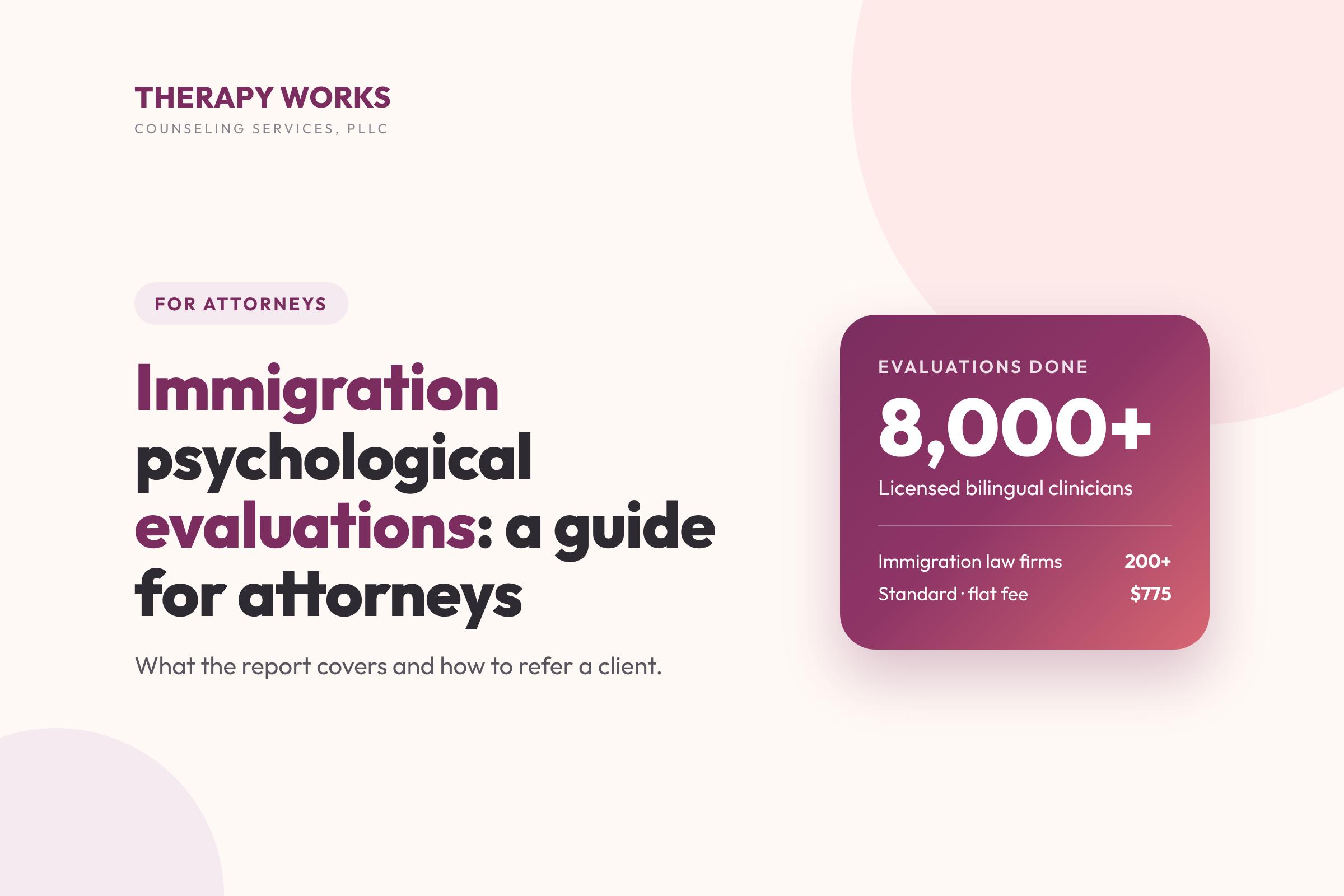
At Therapy Works it is a flat $775 for standard delivery, $875 for express (up to 5 days) and $975 for next day (24 hours). The fee is the same for every relief type and is confirmed on the first call.
How quickly can I get the report?
Standard reports arrive 7–10 days after the evaluation, express in up to 5 days and next day in 24 hours. Express and next-day options depend on clinician availability, confirmed at booking.
Can the evaluation be done in Spanish?
Yes. Our clinicians are bilingual and conduct the interview in English or Spanish. The written report is delivered in English.
What does my firm need to send?
The relief type, your target filing date and how to reach the client. Case facts come from the client directly during the interview, so you do not need to send the file.
Does health insurance cover the evaluation?
No. Immigration evaluations are private pay at a flat fee. Corrections that need no new interview are free.
Refer a client today
Call (972) 695-3421 or message us on WhatsApp with the relief type and filing date. Please leave client names and case details for the call.