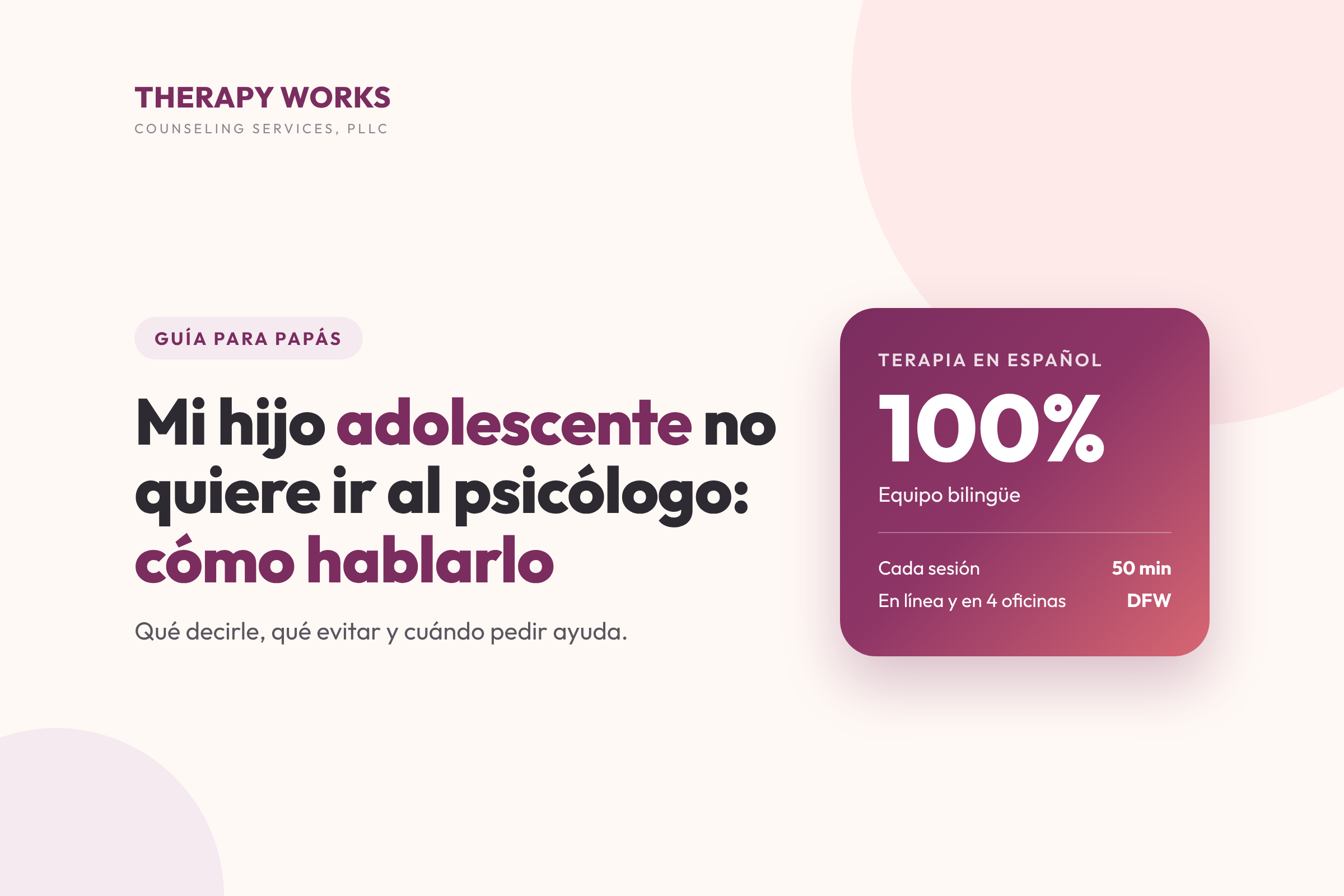
My teen does not want to go to the psychologist: how to talk about it
It is very common for a teenager to say “no” to therapy the first time. What helps most is talking to him calmly, listening to his reasons, and giving him a voice in the decision, rather than forcing or threatening him. At Therapy Works we offer adolescent therapy in Spanish with a 100% bilingual team, online or in Dallas–Fort Worth.
Here are concrete ideas for that conversation: what to say, what to avoid, and when not to expect it.
Why doesn't my teen want to go to the psychologist?
It's almost never “just because.” Behind the "no" there is usually fear or shame. These are the reasons that are heard the most:
- I mean, I’m not crazy. He believes that going to therapy means that something is wrong with him.
- “They're going to scold me.” Think that the psychologist will be on the side of the parents.
- "Anything you say, they'll tell you." You are worried about losing your privacy.
- In vain. He already tried to talk to someone and didn't feel heard.
- It's embarassing He has a hard time talking about what he feels, and more with a stranger.
Knowing what their reason is helps you answer that, and not a “no” in general.
How do I talk about going to therapy?
Choose a quiet time, with no rush and no audience. In the car or walking usually works better than sitting face to face.
- Start with what you observe, not a diagnosis. “I've seen you very tired and locked in your room. I'm worried about how you are.”
- Listen more than you talk. Ask what they think of the therapy and let it end without interrupting.
- Explain what it is and what it is not. Therapy is a space to talk to someone neutral, learn how to manage how you feel, and solve problems. It's not a punishment.
- Real options Choose between online or in person, or schedule. Feeling that you decide something lowers your resistance.
- Propose a test time. “Go to three sessions and then we'll talk about it.” A short commitment is easier to accept.
For more ideas on how to talk to your child, read our article on communication with teenagers (in English)
Which phrases should be avoided?
Some sentences close the conversation before you start:
| Instead of… | TRY WITH: |
|---|---|
| "You're going because I say so." | “I care how you are and I want you to have support.” |
| “You're like this because of you.” | “You can tell something's weighing on you. You don't have to carry it alone.” |
| "The psychologist is going to fix you." | "He's someone who listens to you and helps you find ways out." |
| "You'll see when I tell him everything." | "What you talk about there is yours; I will not be in your sessions." |
Also avoid using therapy as a threat ("if you continue like this, I'll take you to the psychologist"). That makes her a punishment.
Is what you say in therapy confidential?
This is the number one question of teenagers, and it should be clarified from the beginning. In Therapy Works sessions are confidential: what your child shares stays between him and his therapist.
The exception is your safety. If there is a risk to him, the therapist informs you as a tutor. This is explained from the first session, so your child knows what to expect.
Parents participate as support, but taking care of the adolescent's confidence. Explaining this to him usually takes away a lot of fear.
What is adolescent therapy like at Therapy Works?
- 50-minute sessions, usually once a week.
- In Spanish, in English or both. A lot of young people prefer to mix languages, and that's okay.
- Pay online or in personIn our dallas, Bedford, Garland and Frisco offices.
- Topics we work on: anxiety and depression, peer pressure, school stress, family conflicts, behavior problems, self-esteem, and identity.
- We accept insurance such as Blue Cross Blue Shield, Aetna, Cigna, United Healthcare, and Curative.
If your child feels more comfortable from their room, the online therapy in spanish may be the front door. And if the conflicts are whole house, the 9-29 FAMILY PSYCHOTHERAPY PROCEDURES can accompany the process.
When should I not wait for you to accept?
Respecting their rhythm is important, but there are signs that call for action soon:
- Take A. Two weeks or more sad, irritable, or uninterested in anything.
- Much in school or stopped going.
- was isolated of your friends and family.
- He changed his sleep or the way you eat.
- Remarks alcohol or drug intake.
- The city of Getting hurt or that nothing is worth it.
Serving on time makes a difference, as we explained in the importance of early intervention in adolescents. If you see sadness that does not go away, it can also be useful to read what depression looks like.
If your child talks about taking their own life or hurting themselves, don't wait for an appointment. Call, text, or chat with the 988the Suicide and Crisis Lifeline, free, confidential and available 24/7. If there is immediate danger, call 911.
What if she just doesn't want to go?
You can start. Talking to a therapist gives you tools to accompany him at home and to re-propose therapy later.
Sometimes, when the adolescent sees that his parents also ask for help, he stops feeling that the "problem" is him.
Frequently asked questions
Can I force my teenager to go to the psychologist? You can take him, but therapy works best when he is involved in the decision. Listen to their reasons, give them options and propose a trial time before imposing it.
Can parents know what my child says in therapy? Sessions are confidential. The therapist only informs the guardian if there is a risk to the safety of the adolescent, and this is explained from the first session.
Can adolescent therapy be in Spanish? Yes. Our entire team is bilingual and your child can speak in Spanish, English, or both.
How long is a therapy session for teens? 50 minutes, usually once a week. It can be online or at our Dallas–Fort Worth offices.
Does insurance cover therapy for teens? We accept insurance such as Blue Cross Blue Shield, Aetna, Cigna, United Healthcare and Curative. Write to us with the name of your insurance and we will guide you.
Make the first move.
You don't have to have all the answers to help your child. Write to us on WhatsApp or call us at (972) 695-3421 and we'll help you find the right bilingual therapist for your child. Learn more about our adolescent therapy in Dallas.