VAWA Assessment: What You're Asked and How to Prepare
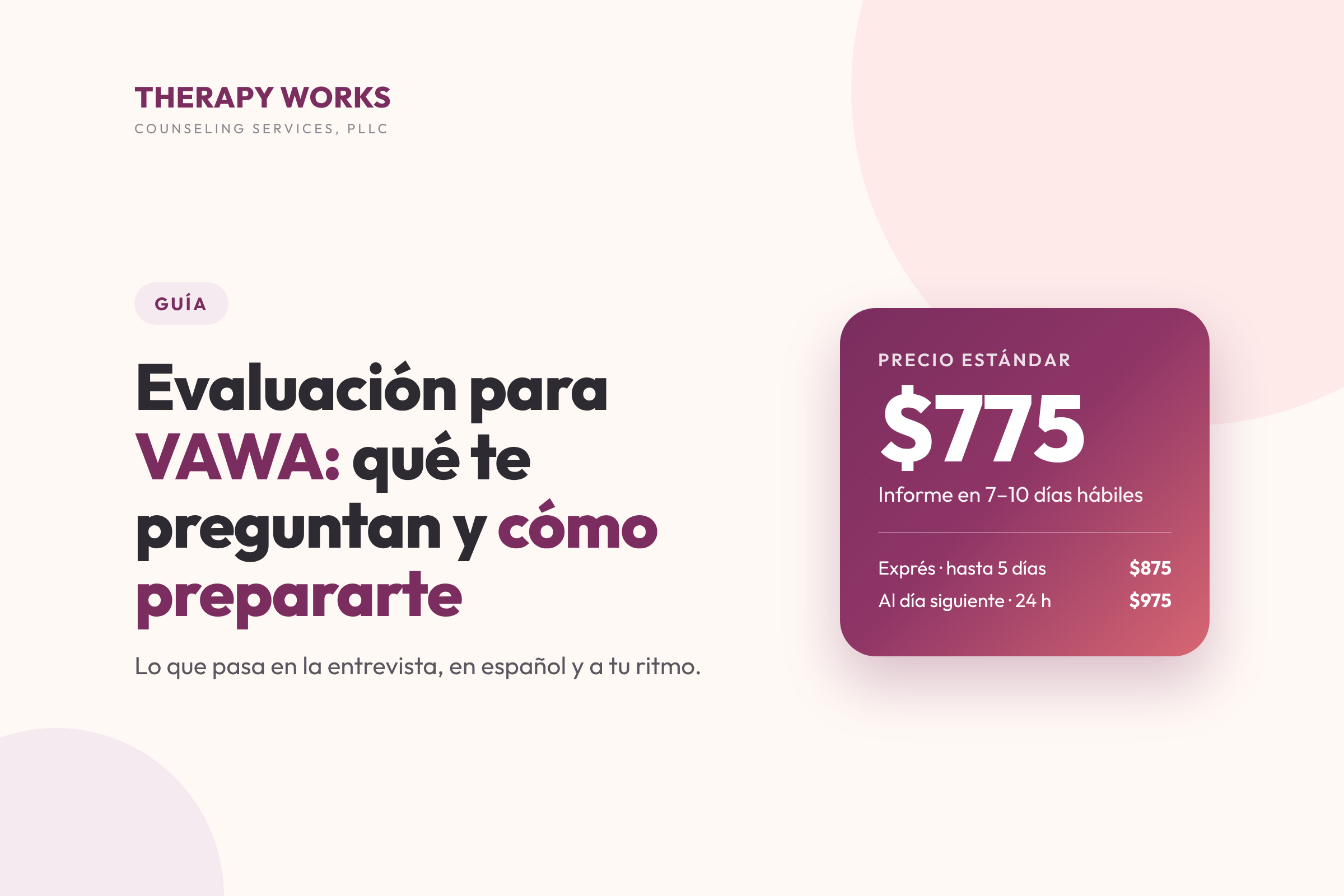
During a psychological evaluation for VAWA, a licensed therapist interviews you in Spanish about your history, the relationship and how the abuse has affected you, and applies validated psychological tests. With that you write a report for your lawyer, who can file it with your VAWA self-petition. At Therapy Works it costs $775, with the report in 7-10 business days.
If your lawyer asked for this assessment, here's what to expect, what questions are often asked, and how to prepare to make it as smooth as possible.
What is VAWA?
VAWA is the Violence Against Women Act, although it protects people of any gender. USCIS, allows some abused individuals to apply for residency on their own (self-petition), without the abuser knowing, approving, or participating.
USCIS mentions three cases: spouses of a citizen or permanent resident, unmarried children under the age of 21 from a citizen or resident parent, and parents of a citizen 21 or older. The request is made with the Form I-360.
Whether your case qualifies and how it is presented is decided by your attorney. We do the clinical side; we don't give legal advice.
What is the purpose of psychological evaluation in a VAWA case?
Abuse does not always leave visible marks. It can be physical, but also insults, threats, control of money, isolation from the family or constant fear.
The assessment documents, with clinical data, how that experience has affected you emotionally. You can display, for example:
- Presenting Symptoms, such as anxiety, sadness, sleep problems, nightmares or post-traumatic stress disorder (PTSD).
- How it changed your daily life: work, relationship with your children, friendships, trust in you.
- The relationship between what you lived through and how you feel today, explained by a professional.
It's one more piece of evidence within the case, along with what your attorney gathers.
What do they ask you in the interview?
The interview is in Spanish, with a licensed, bilingual therapist. One or more clinical interviews are scheduled, depending on what your case needs. The most common topics:
- Personal and family history: where you grew up, what your family was like, who supports you today.
- How the relationship started and how it changed over time.
- What you experienced: the type of abuse, when it happened, and how you reacted.
- Now, how do you feel?: sleep, mood, fear, nerves, concentration, appetite.
- How has it affected you? at work, with your children, and in your relationships.
- What helps you get ahead: people, routines, faith, goals.
There are no correct answers. The therapist is not there to judge you or to doubt you: her job is to understand what you experienced and describe it carefully.
What if I have a hard time talking about what happened?
It's normal. Talking about abuse can bring back strong emotions, even if time has passed.
- You can go at your own pace and ask for a break when you need it.
- You can say “I don't remember” or "I'm not sure" if so. It's better than guessing.
- You can cry, be silent, or get angry. The therapist is ready to accompany you.
If you feel like you need support before or after the assessment, that's part of taking care of yourself. Below we tell you how to order it.
What psychological tests are used?
In addition to the interview, the validated psychological instruments that your case requires are applied. These are questionnaires that measure symptoms such as anxiety, depression or post-traumatic stress. [confirm: if you want to name the most used instruments]
Testing gives the report measurable data, beyond the impression of the interview.
WHAT THE REPORT INCLUDES
The report is written in the format your lawyer needs and delivered to you and him. In general, gather your background, what was observed in the interview, the results of the tests and the clinical conclusions about the impact of the abuse on your emotional health.
Describe your situation with clinical honesty. It does not exaggerate or promise anything: its value is that it is professional and credible.
How do you prepare for the assessment?
- Talk to your lawyer first. To schedule you need to have an immigration lawyer, because the report is evidence that he presents.
- Choose a safe, private place if you do it online, where no one will listen or interrupt you.
- Write down important dates or moments if it helps you sort out your memories. You don't have to memorize anything. [confirm: if they ask to carry something in writing or documents]
- Get your phone and email under control to receive messages from the appointment without risk.
- Plan something quiet for later: a walk, a call with someone you trust, rest.
How much does it cost and how long does it take?
The price is the same for VAWA as for any other type of assessment. Just change depending on how fast you need the report:
| report due | Price |
|---|---|
| Standard: 7-10 business days | $775 |
| Express: up to 5 days | $875 |
| Next day: 24 hours | $975 |
Includes clinical interview, psychological testing, and written report. More details in our guide to how much does an immigration psychological assessment cost.
Can I do it online or in person?
Both options work. We attend in person at our dallas, Bedford, Garland and Frisco offices, and by video call in most of the country, including Washington D.C. For now we cannot serve online in Alaska, Hawaii, Iowa, Louisiana, Massachusetts, New Mexico, New York or Oregon.
What does the assessment not do?
- It doesn’t guarantee your case will be approved. No assessment can do this; the decision is made by the immigration authority.
- It is not legal advice. Questions about your case are for your attorney.
- It's not therapy. It is an evaluation for legal purposes. If you want accompaniment to heal, get to know our Individual therapy in Spanish.
We do evaluations for other cases as well, such as the evaluation for Extreme Hardship Pardon. We have been serving the Hispanic community for more than 15 years, with more than 8,000 evaluations and more than 200 immigration offices working with us.
What if you're not safe today?
If you are in immediate danger, call 911. To talk to someone confidentially, the National Domestic Violence Hotline 24-hour Spanish: Call 1-800-799-7233 or send START to 88788.
Frequently asked questions
What do they ask me at the psychological evaluation for VAWA? About your personal history, the relationship, the abuse you experienced, and how you feel today. You also answer psychological questionnaires. You go at your own pace and can ask for breaks.
Do I need a lawyer to do the evaluation? Yes. We ask you to have an immigration lawyer before scheduling, because the report is prepared in the format he needs.
How much does the VAWA assessment cost? $775 with the report in 7 to 10 business days. If you need it sooner, $875 in up to 5 days or $975 the next day. Health insurance doesn't cover it.
Will the person who hurt me find out? According to USCIS, the VAWA self-petition is filed without the abuser's knowledge or involvement. For our part, the report is given only to you and your attorney, and what you tell is protected by law (HIPAA).
Can I take the assessment online? Yes, by video call almost all over the country. Find a private and safe place where you can talk calmly.
Schedule your assessment for VAWA
If your attorney asked you for a psychological evaluation for VAWA, email us on WhatsApp or call us at (972) 695-3421. We explain the process calmly and usually give you an appointment the same week. Get all the details on our psychological evaluations for immigration.