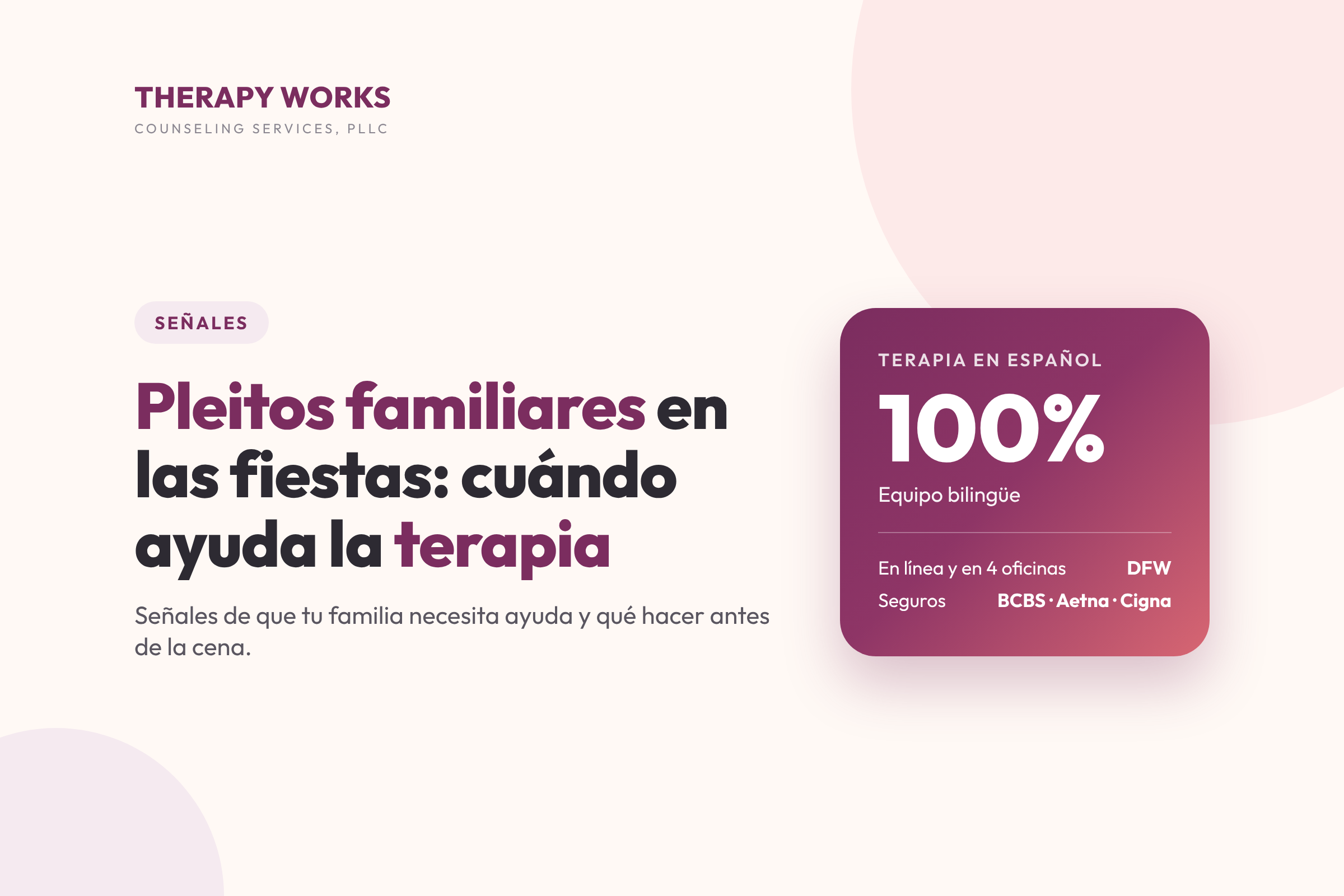
Family feuds during the holidays: When family therapy helps
Quick Response: If every Thanksgiving or Christmas ends in the same argument, the problem isn't the date: it's a pattern that the family hasn't been able to change on its own. Family therapy helps to break this pattern with a therapist who does not take sides. At Therapy Works, it is available in Spanish, online, or at our 4 offices in Dallas–Fort Worth.
Holidays bring together people who hardly spend time together the rest of the year. If in your family that ends in yelling, silence, or someone leaving before dessert, you're not the only one. family therapy in spanish It serves precisely that purpose: to understand why the same argument keeps happening and to learn how to talk without everything blowing up.
Why are there more family disputes during the holidays?
In December, many things come together at once. It's not that your family is "worse" than others.
- More time together: Long periods of time together, little space, and little rest.
- High expectations: Everyone wants the “perfect” party, and nobody achieves it.
- Money: gifts, trips, and who pays for dinner.
- those old wounds The usual comments that touch on open-ended topics.
- some changes in the family happen. A divorce, a new partner, someone who is no longer here.
- Distance: family members far away, or the homesickness of not being in your home country. If that weighs on you, read about the Migratory grief during the holidays.
What are the most common disputes on the table?
They are almost always the same, just wearing different clothes:
- Between generations Parents have opinions about how you raise your children, or grandparents don't understand their grandchildren.
- With adolescents: Glued to their phones, with no desire to socialize, and argumentative.
- with the partner. which family to spend each holiday with, or comments from the in-laws.
- Whith brothers and sisters Who takes care of Mom? Who contributes more? Who “always gets their way”?
- Politics, religion, and life decisions: the topic that someone brings up “just to annoy.”
If you're the one who always calms everyone down, this article about Being the strong daughter It might make sense to you.
When is an argument a sign that family therapy is needed?
An occasional disagreement is normal. It is worth seeking help when you see these signs:
- The same dispute is repeated every year, with the same phrases.
- Someone no longer wants to come or avoids meetings.
- PROHIBIED ITEMS that no one touches so as not to fight.
- Children or adolescents bear the burden of the conflict: take sides or isolate themselves.
- The anger lasts for weeks and after the event.
- There is yelling, name-calling, or humiliation that became “normal.”
- A big change hasn't been discussed: a separation, a move, an illness, or a loss.
If you recognize two or more, it doesn't mean that your family is “broken.” It means that you need another way to talk.
What can you do before this year's dinner?
Therapy isn't the only thing. These ideas help to lower tension right away:
- Set a time limit: Decide beforehand what time you're leaving.
- Have an exit line: “We'll talk about that another day” and change the subject.
- Talk to your partner beforehand: Agree on topics to avoid and a signal to withdraw.
- Give everyone a task: Cooking, serving, or playing with the children reduces friction.
- Take a breath. Go for a five-minute walk if you feel like you're going to explode.
- Don't resolve everything at the table: A party is not the place to heal years-old wounds.
How does family therapy work?
Bring together several family members with a bilingual therapist to improve communication, resolve conflicts, and understand each person's role. The therapist does not take sides or look for culprits: she helps you see the whole pattern.
At Therapy Works, we work with proven approaches such as structural, systemic, cognitive-behavioral, and narrative therapy. Sessions are 50 minutes long, and there are also packages of multiple sessions and intensives lasting 100 to 150 minutes.
Do they all have to go? Not necessarily. The therapist decides who participates in each session: sometimes the whole family, sometimes just the parents, or some of them. It can be parents and children, grandparents, or anyone important to the family.
If the conflict is mainly with your partner, perhaps the following would be more useful for you: couples therapy in spanishAnd if it's with a teenager who doesn't want to go, read How to talk to your teenage child about going to a psychologist.
Is family therapy offered in Spanish and online?
Yes. Our team is 100% bilingual, and during sessions they can mix Spanish and English without any problem, which is useful when the grandparents speak Spanish and the grandchildren speak English. They offer in-person sessions in Dallas, Bedford, Garland, and Frisco, or video sessions with the Online Therapy, on a secure HIPAA-certified platform.
We accept insurance plans such as Blue Cross Blue Shield, Aetna, Cigna, and UnitedHealthcare, among others. Check the details at Does my insurance cover therapy?.
What if the dispute becomes dangerous?
If someone is in immediate danger, call 911. If you or someone in your family is in emotional crisis or is thinking about harming themselves, call or text 988: the Suicide and Crisis Prevention Line 988 It is free, confidential, and available 24/7.
Frequently Asked Questions About Family Therapy
Does the whole family have to go to family therapy? Not necessarily. The therapist decides who participates in each session: sometimes everyone, sometimes just the parents, or part of the family.
How long does a family therapy session last? At Therapy Works, sessions last 50 minutes. There are also packages of multiple sessions and intensives lasting 100 to 150 minutes.
Can we mix Spanish and English in the session? Yes. The entire team is bilingual, so everyone can speak in the language they feel most comfortable with.
Is family therapy online or in person? Both. You can come to Dallas, Bedford, Garland, or Frisco, or connect via video from home.
Does the insurance cover family therapy? We accept insurance providers such as BCBS, Aetna, Cigna, and UnitedHealthcare, among others. We help you verify your coverage before you start.
Do you want this holiday season to be different?
You don't have to wait until January or for “the next argument” to happen. Write to us and we will help you find the right therapist for your family. You can also see our offices and hours.
Write to us on WhatsApp · or call (972) 695-3421