What is a U Visa, and what does it have to do with mental health?
The U Visa (U Nonimmigrant Status) is a protection for victims of certain crimes. Federal regulation, 8 CFR 214.14, asks the person to demonstrate four things:
- Having suffered substantial physical or mental abuse as a result of the crime.
- Having information about the crime.
- Having helped, being helping, or being able to help the authority investigating or prosecuting you.
- That the crime occurred in the United States or violated a federal law.
Mental health falls under the first point. Emotional damage cannot be seen on an X-ray, but it can be described, measured, and explained. This is where assessment helps.
What does the psychological evaluation for a U Visa document?
The report describes how the crime affected you internally and in your daily life. The regulation mentions factors such as the nature of the harm, the seriousness of what the perpetrator did, the severity of the harm, how long it lasted, and whether it made something you already had worse. It also clarifies that a series of acts, taken together, can count as substantial abuse.
A therapist translates it into clinical language. For example, the report may describe:
- Symptoms such as constant fear, nightmares, startles, or unwanted memories.
- Changes to your routine: stopping going out, working as before, or sleeping well.
- Effect on your relationships: with your partner, your children, or your community.
- Duration: if symptoms persist for months or years afterwards.
- What you already had: if the crime worsened something that existed before.
Many people experience symptoms of trauma after a crime. If you want to understand it better, read our article on PTSD beyond stereotypes.
Is it the same as police certification?
No. They are two different documents and have different functions:
| Psychological Assessment | Certification (Form I-918, Supplement B) | |
|---|---|---|
| who makes it? | Licensed Therapist | Authority investigating or prosecuting the crime |
| What it Displays | The emotional harm you suffered | That you helped or can help with the case |
| Who's ordering it | Your attorney, if you consider it useful | It is part of the request |
The main request is the USCIS Form I-918. The regulation states that “any credible evidence” may be submitted. The evaluation is one piece of such evidence, along with what your attorney gathers.
What is the U Visa assessment interview like?
The interview is a conversation in Spanish with a licensed therapist, plus validated psychological tests. It is conducted at one of our Dallas–Fort Worth offices or by video. The video interview is just as valid as an in-person interview.
The therapist will calmly ask you about:
- Your life before the crime: family, work, routine.
- What happened, with as much detail as you can share.
- How you have felt since then and what has changed.
- Your physical and emotional health, and whether you have received care.
You can ask for breaks. You don't have to have everything clear or tell it “right.” The therapist does not judge you or decide your case: she documents what you are experiencing.
How much does the report cost and how long does it take?
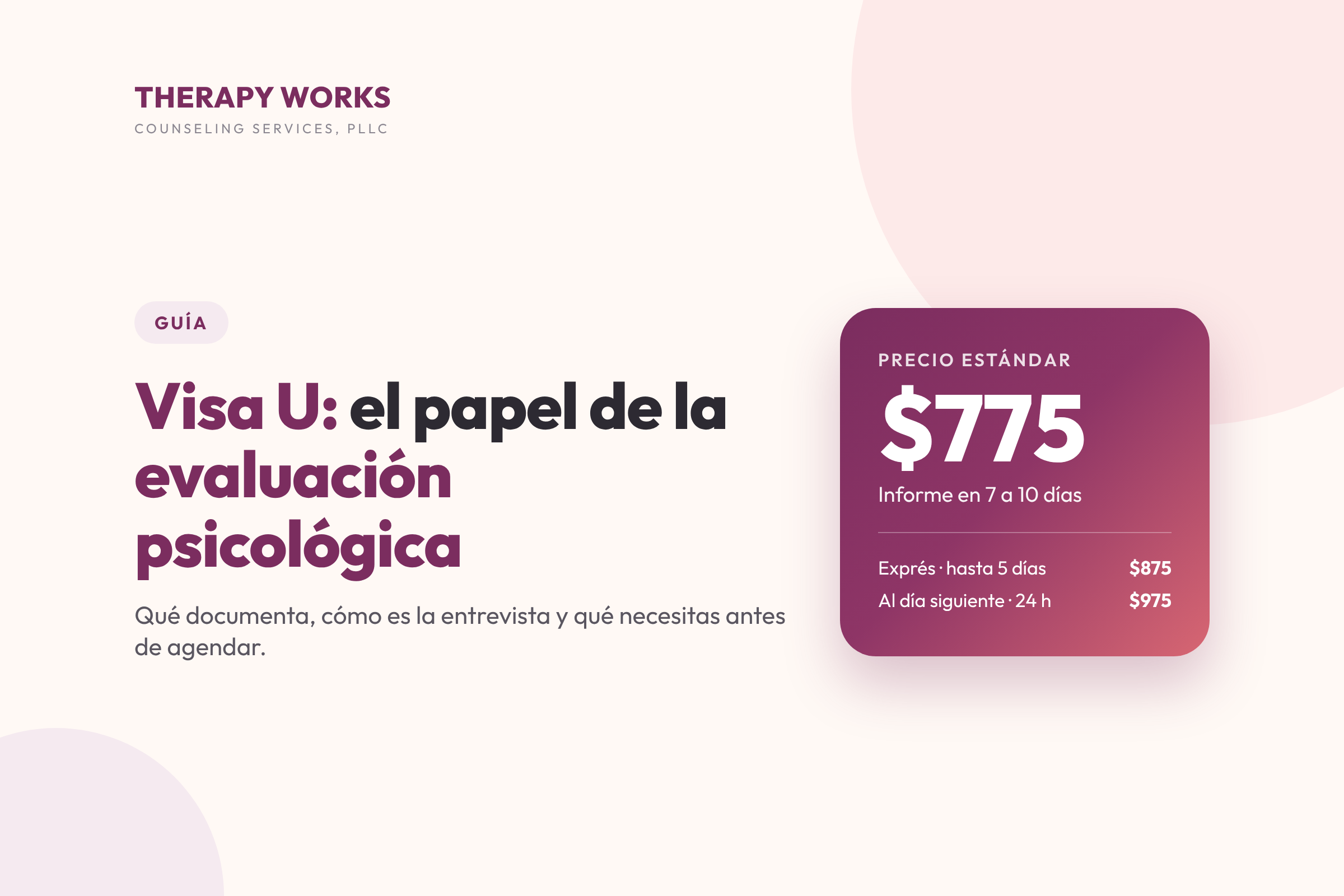
The price is the same for any type of evaluation. It includes the full interview, the tests required for your case, and the written report, with no hourly fee or separate charge for the report.
| Option | report due | Price |
|---|---|---|
| Standard | 7–10 days | $775 |
| Express | Up to 5 days | $875 |
| The next day | 24 hours | $975 |
Express and next-day appointments depend on the availability of therapists; we will confirm this when you schedule. Health insurance does not cover immigration evaluations. If you want the full breakdown, please check how much does an immigration psychological assessment cost.
What do I need before scheduling?
The only essential thing is have an immigration lawyer. The report is evidence that your attorney presents; without an attorney, the evaluation is of no use to you. If you don't have one yet, we'll tell you what to ask them.
It helps to have on hand:
- The name and contact information of your attorney, to send them the report.
- Approximate dates of what happened.
- If you have seen a doctor or undergone therapy, any names or documents you have.
You don't need to bring anything you've learned. Nor do you need to have a prior diagnosis.
What is the process with Therapy Works, step by step?
- You call us or write to us. Tell us about your situation, and we'll let you know which assessment applies, the cost, and the timeframe.
- Let's schedule your interview. We'll contact you the same day and try to schedule an appointment for you that same week, Monday through Sunday.
- Interview and tests. With a licensed therapist, in Spanish.
- You receive your report. We will send it to you and your attorney on the date of the option you chose.
Your file is confidential. We do not share it with anyone without your written authorization, not even with your attorney.
Does the assessment guarantee that my U Visa will be approved?
No. No evaluation can guarantee this: the decision rests with the authority. What a good report does is clearly explain the harm you experienced, with clinical support.
Nor is it therapy, even if it is done by a therapist. If, after the assessment, you want to work on what you're feeling, you can start Individual therapy in Spanish with our crew.
What other assessments do we conduct?
In addition to U visas, we conduct evaluations for waivers (extreme hardship), cancellation, T visas, N-648, and mental competence. Two cases are very similar to the U Visa: the VAWA assessment, for survivors of domestic violence, and the asylum evaluation and trauma report.
We have conducted more than 8,000 assessments, and over 200 immigration law firms entrust their clients to us. We offer in-person services in Dallas, Bedford, Garland, and Frisco, and video appointments across most of the United States, except Alaska, Hawaii, Iowa, Louisiana, Massachusetts, New Mexico, New York, and Oregon. Check addresses and hours at Our offices and contact information.
Frequently Asked Questions About the U Visa Psychological Evaluation
Is a psychological evaluation required for the U Visa? This is not a mandatory form. It is evidence that your attorney can present to show substantial emotional harm. Your attorney decides whether your case needs it.
Is the evaluation in Spanish? Yes. The entire interview is conducted in Spanish with a licensed, bilingual therapist. The report is delivered in the format your attorney needs.
Can I take the assessment by video? Yes, in almost all of the United States. We do not currently serve Alaska, Hawaii, Iowa, Louisiana, Massachusetts, New Mexico, New York, or Oregon. The video interview is just as valid as an in-person interview.
How much does the U Visa assessment cost? $775 for standard (7 to 10 days), $875 for express (up to 5 days), and $975 for next-day (24 hours). Health insurance does not cover it.
What if I find it difficult to talk about what I experienced? It's normal. You can ask for breaks and share only what you can. The therapist is there to listen to you, not to judge you.
Ready to take the next step?
If your attorney has asked you for a U Visa evaluation, or if you want to know if you qualify, please contact us. We will respond to you in Spanish and explain the options, costs, and timelines.
Write to us on WhatsApp · or call (972) 695-3421