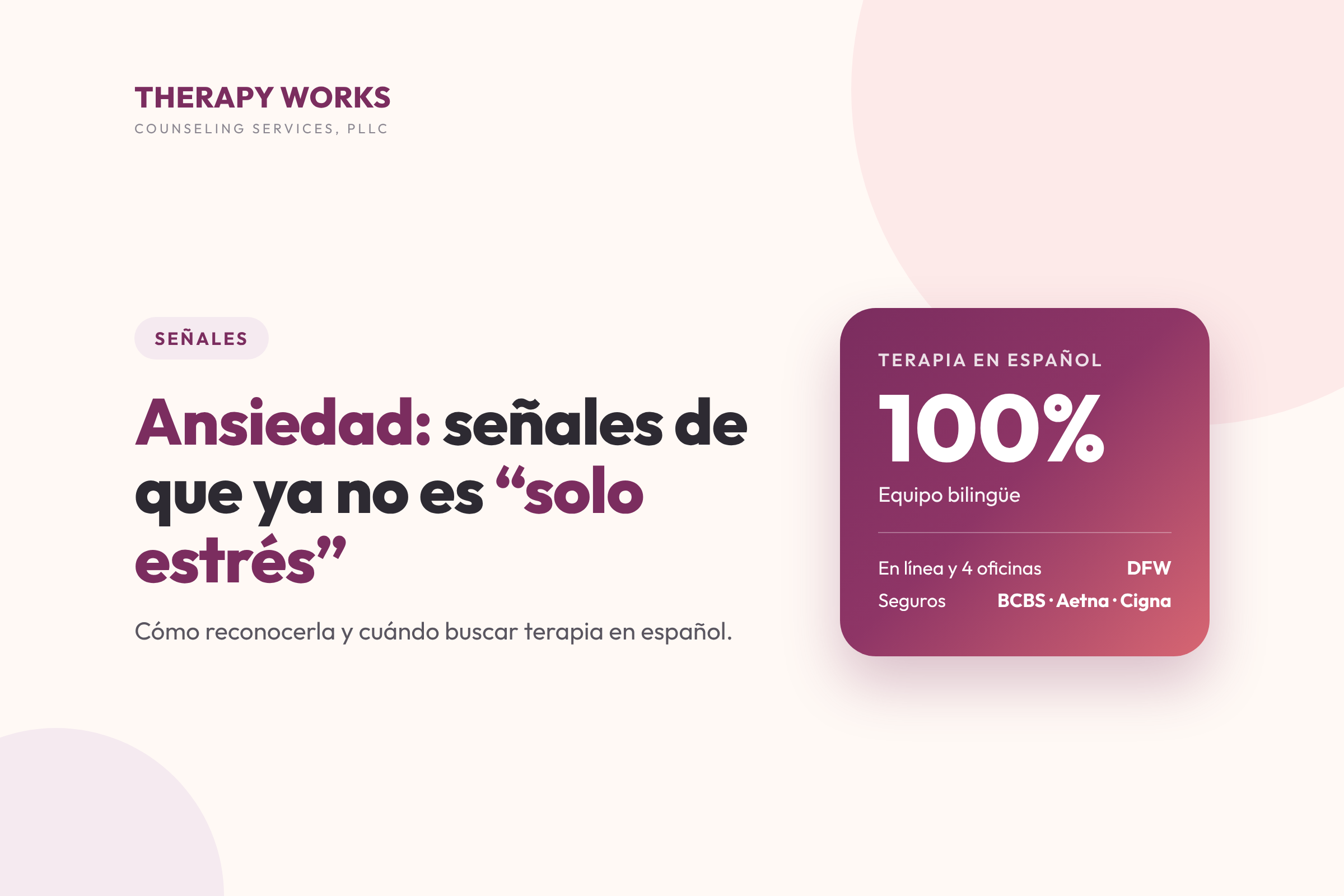
Stress goes down when the problem passes; anxiety stays even if everything is "fine". If worry, tension, or nerves last for weeks, make you sleepy, or keep you from things you used to do, it's worth talking to a professional. At Therapy Works we offer anxiety therapy in spanish with a 100% bilingual team, online or at our Dallas–Fort Worth offices.
Here's how to tell stress from anxiety, what signs to take seriously, and what happens when you decide to ask for help.
What is the difference between stress and anxiety?
The two feel similar: tension, tiredness, a quickened mind. The difference is in what causes them and how long they last.
| Stress | Anxiety | |
|---|---|---|
| What causes it? | Something concrete: an exam, a debt, a job change | Sometimes nothing is clear, or a concern that jumps from one topic to another |
| How long does it last? | Goes down when the situation ends | Keep going even though the situation has passed |
| Your Feelings | "I have a lot on my plate | Something bad is going to happen." |
| How it affects your day | It tires you out, but you're still working | You start avoiding people, places, or tasks |
Feeling stress from time to time is normal and even helpful. The problem is when the alarm stays on all the time.
What signs indicate that it is no longer just stress?
These signs are not a diagnosis, but they are a reason to consult with a professional, especially if they take several weeks:
- You worry almost every day and you can't "turn off" the mind, even though you know you're exaggerating.
- You sleep poorly: you have trouble falling asleep, you wake up at dawn thinking or you wake up tired.
- Your body warns: racing heart, chest pressure, stomach pain, tension in neck and shoulders, tremor or shortness of breath.
- You avoid things: You stop driving, going to meetings, or answering the phone on your nerves.
- You get irritated easily with your partner, your children, or at work.
- *DO YOU HAVE A HARD TIME CONCENTRATING or make simple decisions.
- You have panic attacks: episodes of intense fear that arrive suddenly, with strong physical symptoms.
If the physical symptoms are new or severe, talk to your doctor as well. Some health conditions feel like anxiety.
Why do we sometimes have a hard time recognizing anxiety?
In many Hispanic families we learned to endure. "They are nerves", "feel like it" or "don't tell anyone" are phrases that are heard often. In addition, many people carry work, family here and there at the same time.
That constant effort comes at a cost. If you are always the one who solves everything, you may be interested in our article Being the strong daughter isn't saving you, it's draining you.
Asking for help is not weakness. It's treating anxiety like you would any other health problem.
What can I do today if I'm feeling anxious?
These practices are not a substitute for therapy, but help lower the intensity:
- He is breathing slower: Inhale in 4 strokes and exhale in 6, for two to three minutes.
- Name how you feel: writing "I am worried about..." helps to order the mind.
- Move your body: a short walk lowers physical tension.
- Take care of the basics: sleep schedules, meals, and less caffeine.
- Talk to someone you trust: Putting everything away usually makes it heavier.
If despite this anxiety continues to affect your sleep, work, or relationships, it's time to seek therapy.
How does anxiety therapy help?
In therapy, you learn to understand what triggers your anxiety and respond differently. Your therapist teaches you concrete tools for the recurring thoughts, physical symptoms, and situations you're avoiding.
Therapy Works
- The whole team is bilingual, so you can speak in Spanish, in English, or in both, however you like.
- Sessions are for 50 minutes., in person or by video.
- It's confidential.: What you talk about in session is protected by law (HIPAA).
- We accept most insurances., such as Blue Cross Blue Shield, Aetna, Cigna, United Healthcare, and Curative.
If you don't have time to drive, the online therapy in spanish works from home with the same confidentiality. You can also come to our dallas, Bedford, Garland and Frisco offices.
When should I get help right away?
If you feel like you can't take it anymore, have thoughts of hurting yourself, or that life isn't worth living, don't wait for a date. Call or text 988the suicide and crisis prevention line, with attention in Spanish, free and confidential 24 hours a day. If you are in immediate danger, call 911.
Frequently asked questions
Does the anxiety go away on its own? Sometimes it goes down when the situation that caused it happens. If it lasts for weeks or starts to affect your sleep, work, or relationships, it's best to seek professional help.
How many therapy sessions do I need for anxiety? It depends on each person and what you are experiencing. In the first session, your therapist explains the plan to you and you review it together. [confirm: typical duration of a process for anxiety]
Does insurance cover anxiety therapy? We accept most insurance, including Blue Cross Blue Shield, Aetna, Cigna, United Healthcare, and Curative. Write to us with the name of your insurance and we will guide you.
Does online therapy work for anxiety? Yes. The video session has the same confidentiality as an in-person one and saves you the transfer, something that helps when leaving home already costs work.
Do I need a diagnosis to start therapy? No. You can start with just what you feel. Your therapist does the clinical evaluation in the first few sessions.
Make the first move.
If you recognized yourself in these signs, you don't have to wait for it to get worse. Write to us on WhatsApp or call us at (972) 695-3421 and we'll help you schedule with a bilingual therapist. Learn more about our individual therapy for anxiety in Dallas.