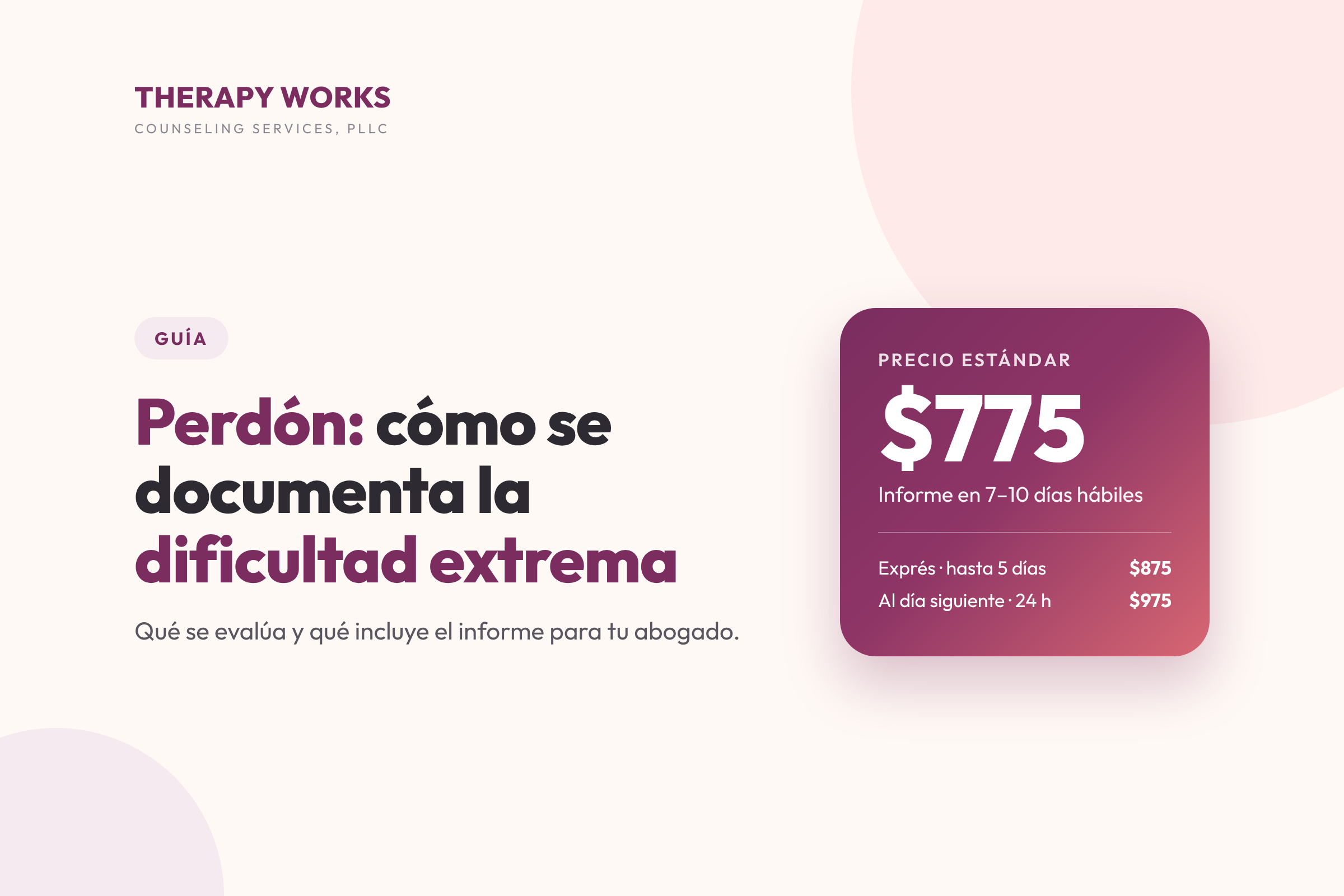
An psychological evaluation for Forgiveness documents, with a clinical interview and validated evidence, how it would emotionally affect your citizen or resident family member if the request for a Pardon were denied. It is one of the tests that your lawyer can present with the I-601 or I-601A waiver to show the “extreme difficulty”. At Therapy Works it costs $775, the report is ready in 7-10 business days and the interview is in Spanish.
If your lawyer asked for it, here's what extreme hardship is, what's evaluated, what's in the report, and how to prepare.
What is Immigration Forgiveness and what does “extreme hardship” mean?
The “Pardon” is the name we use for a waiver or special permit that is requested from USCIS. The best known are the Form I-601, the request for waiver of grounds of inadmissibility, and the Form I-601A, provisional pardon for unlawful presence.
In many of these cases, it must be demonstrated that a close family member, citizen or permanent resident, would suffer a Extreme difficulty (in English) extreme hardship) if the request is denied. It is not enough to say that the family would be sad: you have to show with evidence how your life would change.
USCIS explains how it analyzes extreme hardship in its official policy guide (Policy Manual, volume 9, part B). Which form applies to you and who your qualifying family member is is decided by your attorney; we do not provide legal advice.
What is the purpose of psychological evaluation in a Forgiveness case?
Extreme difficulty is armed with several tests: economic, medical, school documents, letters and more. The psychological evaluation provides the emotional part, with clinical data and not just with words.
For example, you can document:
- Presenting Symptoms of your family member, such as anxiety, constant sadness, sleep problems, or post-traumatic stress.
- How much it depends emotionally from you, and what role you play in the daily life of the family.
- How it would affect you separation, or having to move to another country to stay together.
- Factors that make you more vulnerable, such as caring for children or older parents, or treatments you already receive.
The report gives the officer a professional and independent look at what your family is going through. Your attorney decides how to use it within the case.
Who is evaluated?
Normally, the relative who would experience the extreme difficulty is interviewed, because it is their situation that the case has to show. [confirm: whether the applicant or children are also interviewed, and in what cases]
Your attorney will tell you who to evaluate based on your case. If you have any questions, we can resolve them in the initial consultation.
What is asked in the interview?
The interview is conducted by a licensed, bilingual therapist, in Spanish. One or several clinical interviews are scheduled, depending on what the case needs. If you are the person being evaluated, these are the most common topics:
- Personal and family history: where you grew up, how your family is formed, how they met.
- The relationship with the person in the case: what their day-to-day life is like together and what responsibilities they share.
- Your emotional health today: sleep, mood, worries, nerves, changes in appetite or concentration.
- What you imagine if separation comes: what would happen to the work, children, home, and support you receive.
- Your physical health and treatments, if there are any, and who accompanies you in them.
There are no good or bad answers. What helps most is to speak truthfully, even if it costs. The therapist knows these are difficult topics and is going at your pace.
What psychological tests are used?
In addition to the interview, the validated psychological instruments that your case requires are applied. They are standardized questionnaires that measure symptoms such as anxiety, depression or post-traumatic stress. [confirm: if you want to name the most used instruments]
Testing gives the report measurable data. Thus, the result does not depend only on the impression of the interview.
WHAT THE REPORT INCLUDES
The report is written in the format your lawyer needs and delivered to you and him. In general, it gathers:
- The Antecedents of the person being evaluated and the family.
- What was observed in the interview assesment.
- The Results Psychological testing
- Clinical conclusions about the emotional impact of the separation or move.
The report describes the situation with clinical honesty. It does not exaggerate or promise anything: its value is that it is professional and credible.
How do you prepare for the assessment?
- Talk to your lawyer first. To schedule you need to have an immigration lawyer, because the report is evidence that he presents.
- Have at hand what your lawyer asks yousuch as medical or treatment information. [confirm: documents to bring to the interview]
- Find a quiet spot. if you do it online, where you can speak with privacy.
- Don't memorize answers. Tell your story as it is; the therapist guides you with questions.
- Speak in whichever language comes out. The entire team is bilingual.
Preparing is also taking care of how you feel. Expecting a migratory response tires, and if you notice that the nerves don't go away, read our article on signs that anxiety is no longer just stress.
How much does it cost and how long does it take?
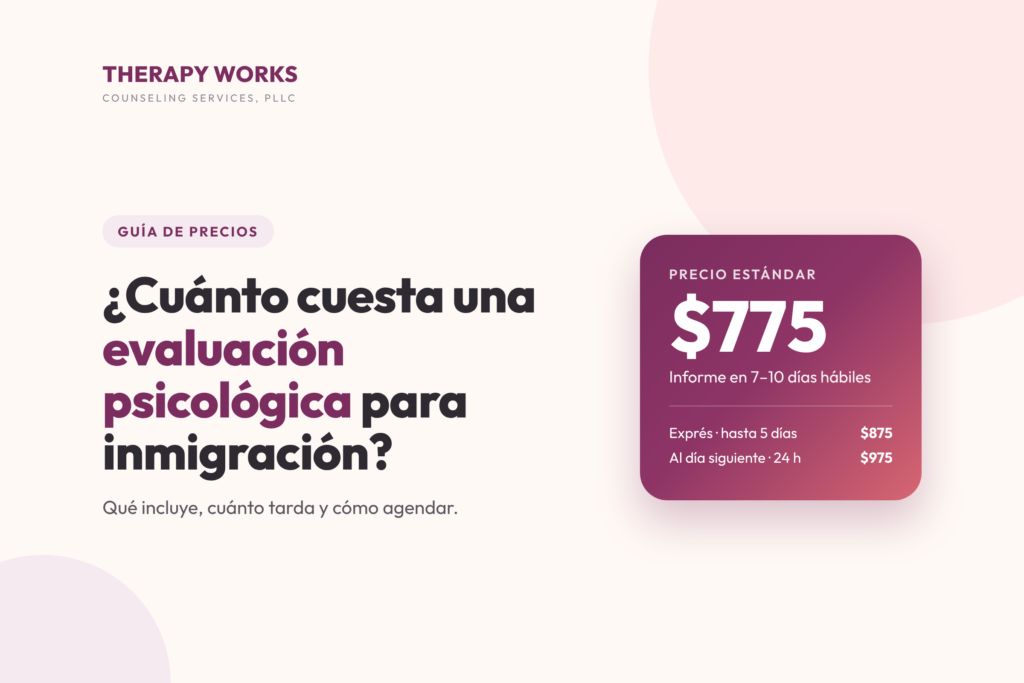
The price is the same for Forgiveness as for any other type of assessment. Just change depending on how fast you need the report:
| report due | Price |
|---|---|
| Standard: 7-10 business days | $775 |
| Express: up to 5 days | $875 |
| Next day: 24 hours | $975 |
Includes clinical interview, psychological testing, and written report. If you want to compare with other places, check out our guide to how much does an immigration psychological assessment cost and what does it include.
Can I do it online or do I have to go in person?
Both options work. We attend in person at our dallas, Bedford, Garland and Frisco offices, and by video call in almost the entire country, including Washington D.C.
We are currently unable to serve online in Alaska, Hawaii, Iowa, Louisiana, Massachusetts, New Mexico, New York, and Oregon.
What does the assessment not do?
- It doesn’t guarantee your case will be approved. No assessment can do this; the decision is made by the immigration authority.
- It is not legal advice. Questions about your case are for your attorney.
- It's not therapy. It is an evaluation for legal purposes. If you or your family need emotional support, know our Individual therapy in Spanish.
We have been serving the Hispanic community for more than 15 years. We have done over 8,000 evaluations and work with over 200 immigration law firms.
Frequently asked questions
What is the extreme difficulty in Forgiveness? It is the serious harm that your citizen or resident family member would suffer if your waiver application is denied. It is demonstrated with evidence, and the psychological evaluation documents the emotional part.
Is psychological evaluation mandatory for I-601 or I-601A? Your attorney decides if your case needs it. It is a test that is added to the others to show the extreme difficulty.
How much does the Forgiveness assessment cost? $775 with the report in 7 to 10 business days. If you need it sooner, $875 in up to 5 days or $975 the next day. Payment is made on the day of the assessment, prior to submitting the report.
Does health insurance cover the assessment? No. It's an evaluation for legal purposes, not treatment, so insurance doesn't cover it.
Is what I say in the interview confidential? Yes. What you share with the therapist is protected by law (HIPAA). The report is given to you and your attorney for use as you authorize.
Schedule your review for Forgiveness
If your attorney asked you for an extreme hardship assessment, email us on WhatsApp or call us at (972) 695-3421. We explain the process and usually give you an appointment the same week. Get all the details on our psychological evaluations for immigration.
Pending before publishing
Prices, deadlines, process, lawyer requirement, "one or more interviews", payment on the day of the evaluation, excluded offices and states leave therapyworkscounseling.com/evaluaciones, revised October 6. 6 pending:
- Therapist who reviews and signs the article: name and credential for the Article schema. Above all, review the topics of the interview and the section of the report.
- [confirm: who is evaluated] If the applicant or children are also interviewed, and in what cases.
- [confirm: instruments] Name the most used or delete the brand and leave the general phrase.
- [confirm: documents to bring to the interview]
- Optional Allied Lawyer Paragraph Review on I-601, I-601A and Extreme Hardship. USCIS blocked chapter 5 of the Policy Manual (error 403), so no specific factors are cited; part B is linked, which I did open.
- Publish before Blog 01 (13-Oct) and Blog 02 (15-Oct) with the slugs of your file, so that the two internal links of the series work.
There is no mention of ESPERANZA10, discounts, guaranteed results or migratory consequences as a threat. The status of the reader is not presupposed.