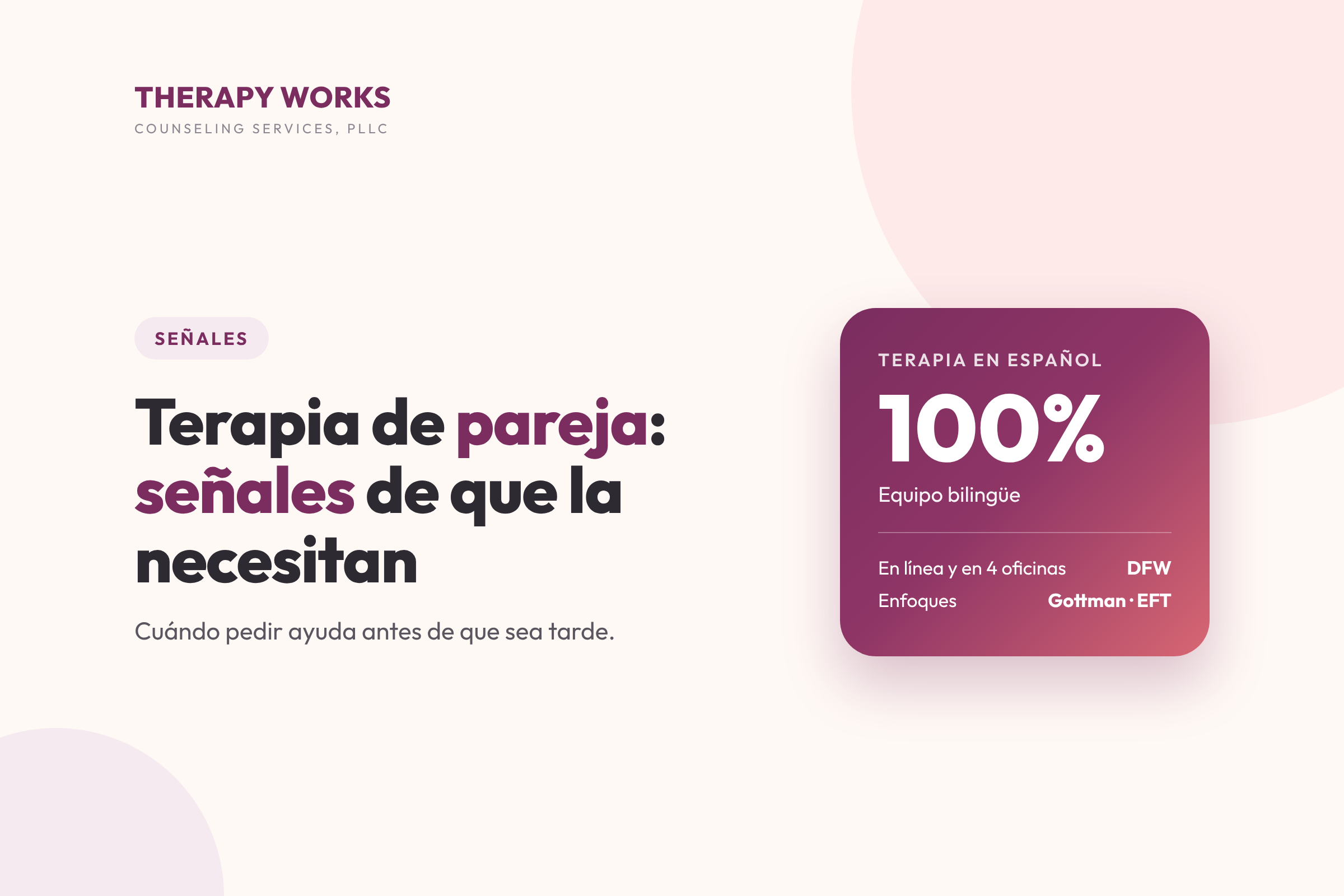
Couples therapy: Signs they need it before it's too late
It is convenient to search couples therapy in spanish when they always argue about the same thing without resolving it, when they hardly speak anymore or when a crisis, such as an infidelity, took away their confidence. No need to wait to be on the verge of separation. At Therapy Works, you can get started in Spanish, online, or at our Dallas–Fort Worth offices, even if your partner doesn't want to go yet.
When is it time to go to couples therapy?
Many couples arrive when they are already very tired. The sooner they ask for help, the easier it is to change the patterns that are hurting them.
In many Hispanic families we were taught that “house problems stay in the house.” Asking for help is not exposing your partner or giving up: it is taking the relationship seriously.
What signs indicate that they need couples therapy?
Here are some common signs. If they recognize two or three, it's worth talking to a therapist:
- They always argue about the same thing. Money, family, children or housework, and they never come to an agreement.
- They don't talk anymore, they just coordinate. The conversations are about payments, schedules, and pending, not about you.
- The fights go up quickly. A small comment ends in shouting, or one of the two closes and stops responding.
- There is distrust or jealousy that does not calm down. Especially after a lie or infidelity.
- Intimacy changed. There is less closeness, less affection, or sexual problems that they don't know how to talk about.
- They don't agree on parenting. The children notice the tension and sometimes get caught in the middle.
- They experience a great change. A baby, a move, the loss of a job, the family that comes to live with you or the distance due to migration.
- One already thinks of separating. Even if he didn't say it out loud.
Which patterns harm a partner the most?
Researcher John Gottman identified four ways to discuss that, when they become customary, wear down the relationship. He called them The four horses:
| Boss | What it looks like |
|---|---|
| Critical | Attacking the person instead of the problem: “You never think about anyone.” |
| Contempt | Mockery, sarcasm, blank eyes, feeling superior. |
| Defensiveness | Justifying or blaming yourself instead of listening. |
| Evasion | Shutting down, staying quiet, or leaving the conversation. |
According to the Gottman Institute, contempt is the most predictive of divorce. The good news is that they are habits, and habits can be changed with practice and accompaniment.
What if my partner doesn't want to go to therapy?
You can start. Working on how you communicate and on your boundaries can change the dynamics of the relationship. Later your partner can join, if they so choose.
If you prefer a space just for you, you can also start with Individual therapy in Spanish.
What happens in a couples therapy session?
The therapist listens to both of you and helps you understand what is pulling you apart. He does not take sides: his job is to take care of the relationship and the well-being of both.
- Duration: 50-minute sessions. There are also multi-session and intensive packages from 100 to 150 minutes.
- Language: in Spanish, English or both, as they feel most comfortable.
- Approaches Emotion Focused Therapy (EFT), Gottman Method, Systemic Therapy, and Nonviolent Communication.
- Topics: communication, infidelity, jealousy and trust, parenting, intimacy, stress and life changes.
Does online couples therapy work?
Yes. They can connect by video from home, or each one from their place if they work at different times. The sessions of Online Therapy are on a secure, HIPAA-certified platform.
If you prefer to come in person, we serve Dallas, Bedford, Garland, and Frisco. You can see the addresses on our contact and offices.
When does couples therapy not come first?
If there are blows, threats, control or fear in your relationship, couples therapy is not the first step. In those cases, the most important thing is your safety. You can call 24/7 at National Domestic Violence Hotline 1-800-799-7233, or send START to 88788.
If you or your partner are thinking about harming yourself, call or text the 988 Suicide and Crisis Lifeline. In an emergency, call 911.
Frequently asked questions
How do I know if we need couples therapy? If they always argue about the same thing, they no longer feel close, there is distrust or one thinks of separating, it is a good time to ask for help. No need to wait for a crisis.
Is there couples therapy in Spanish in Dallas? Yes. At Therapy Works the entire team is bilingual. We serve in person in Dallas, Bedford, Garland, and Frisco, as well as online.
Can I go to couples therapy without my partner? Yes. You can start on your own or on your own, and your partner can join later.
Is the therapist going to take sides? No. Your role is to support the relationship and well-being of the two of you.
Does insurance cover couples therapy? We accept most insurances, but couples coverage depends on your plan. We verify it without obligation before starting.
Schedule your first session
If you recognized yourself in these signals, you don't have to wait for the relationship to bottom out. Write to us on WhatsApp or call us at (972) 695-3421. Your first consultation is no strings attached. Learn more about our spanish Couples Therapy in Dallas.